


Centre for Online and Blended Learning
Great Learning with Smarter Features
Experience the best of both worlds with our innovative model that combines the flexibility of online learning with the depth of classroom interaction. Our courses are structured to offer enriched engagement, continuous mentoring, and practical application
Breaking Language Barriers
PMIST MOOC supports learners from diverse backgrounds with courses offered in multiple languages, ensuring inclusivity and wider reach for quality education.
Flexible Blended Learning
Access high-quality course content anytime, anywhere. Our self-paced modules and interactive resources allow learners to balance education with personal and professional commitments.
Active Community Support
Engage with a vibrant learner community and expert faculty through discussion forums, peer networks, and prompt academic assistance that fosters collaborative growth.
Responsive Design
PMIST digital learning platform is optimized for all devices, offering a seamless learning experience in desktops, tablets, and smartphones with intuitive navigation and clear structure.
Skip course categories
Course categories
Skip available courses
Available courses
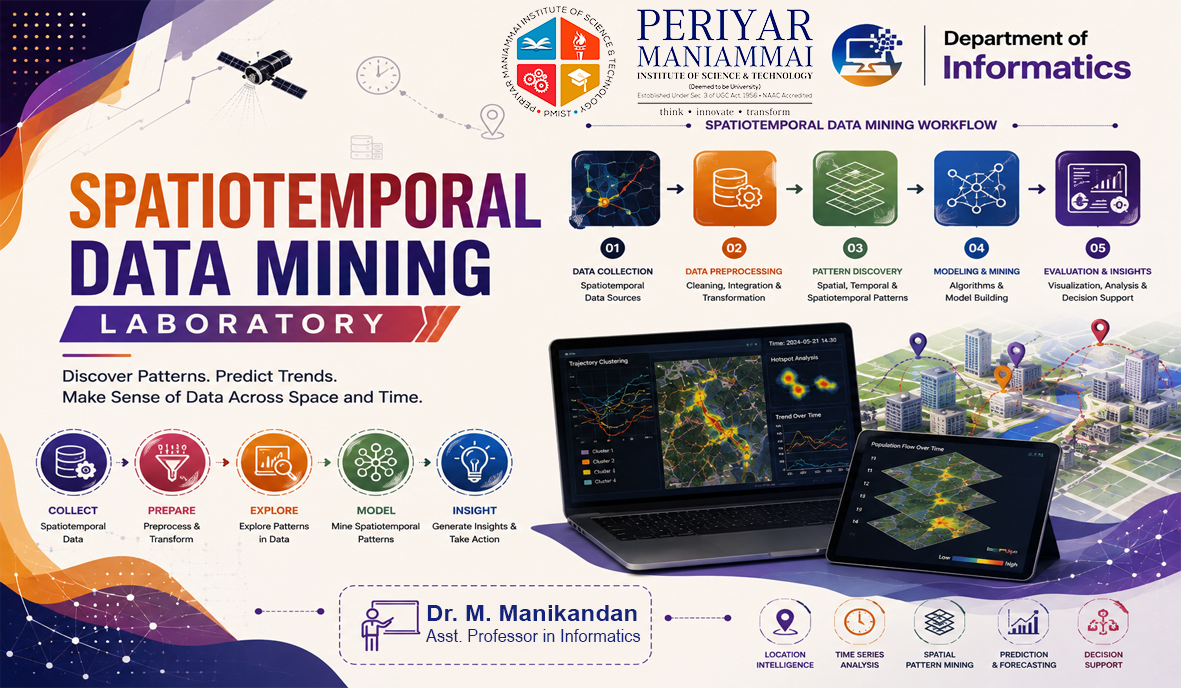
Spatiotemporal Data Mining Laboratory course offers hands-on experience in mining and analyzing spatio-temporal data using modern data science techniques. Through real-world case studies and SDG-aligned activities, students will apply preprocessing, pattern discovery, forecasting, and visualization methods to spatial, temporal, and integrated datasets. The course culminates in a mini-project that demonstrates the application of learned techniques for societal and environmental insights.
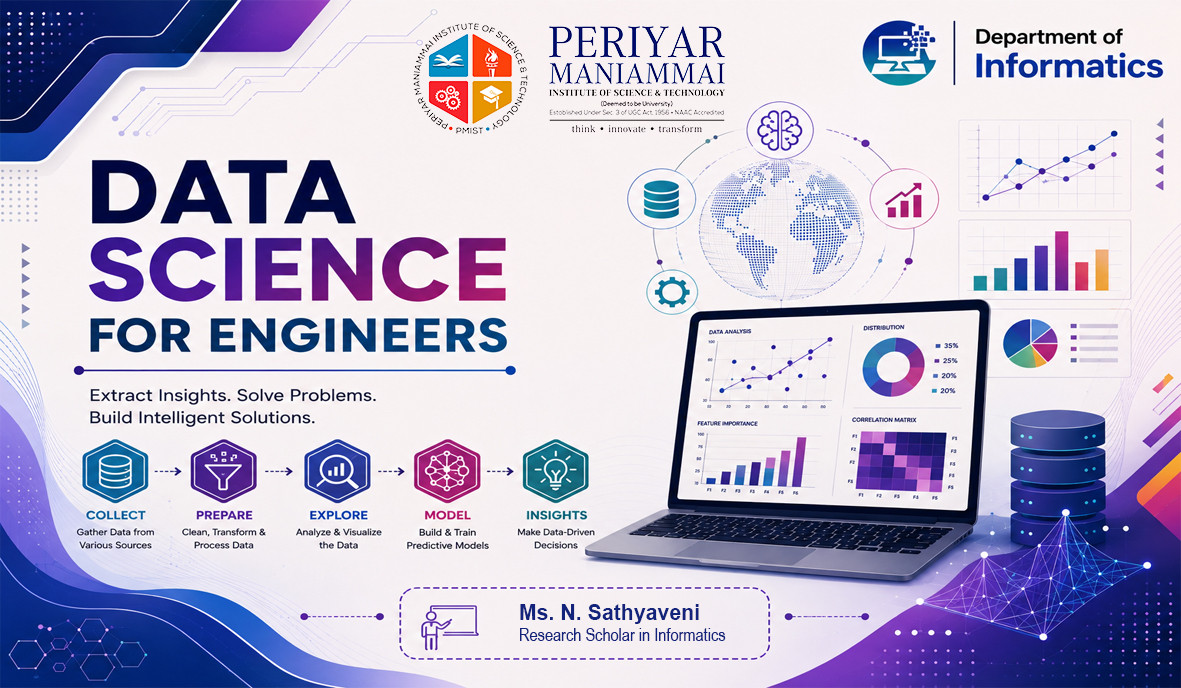
This Data Science for Engineers course introduces the mathematical, statistical, and computational foundations of data science using R programming. It covers linear algebra, probability, optimization, regression, classification, and clustering techniques, enabling learners to analyze data, build predictive models, and solve real-world data science problems using a systematic analytical framework.
- Teacher: SATHYAVENI N
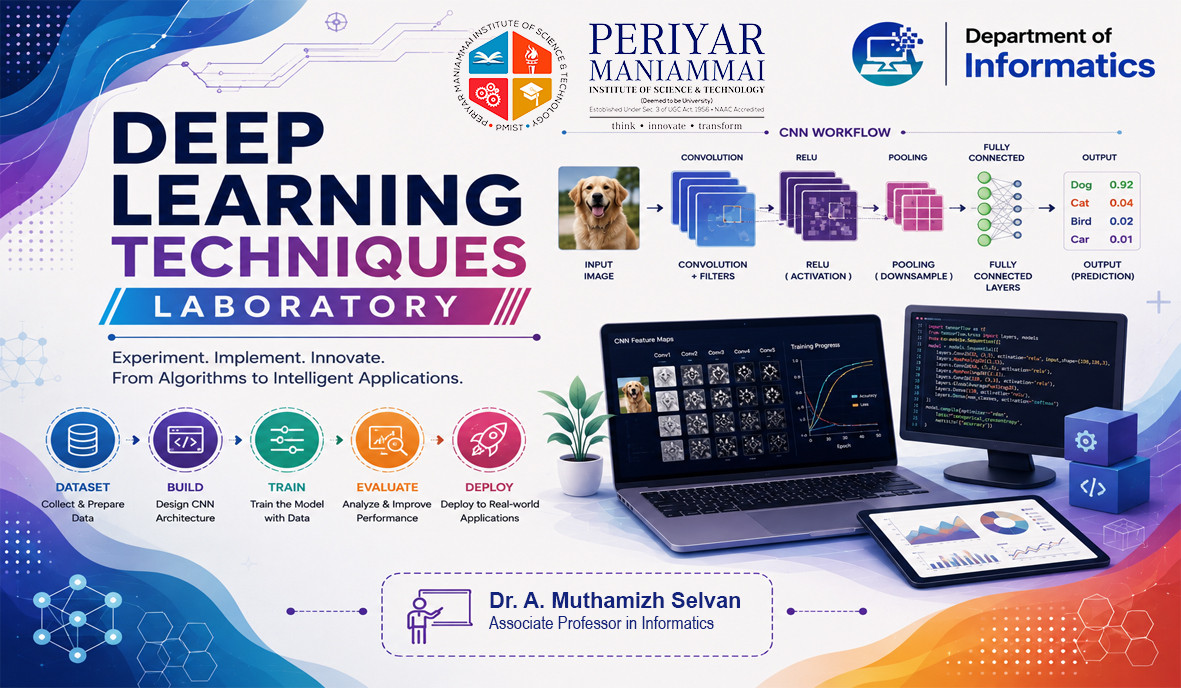
This Deep Learning Techniques Laboratory course provides hands-on exposure to implementing, training, and evaluating deep neural network models using Python libraries such as TensorFlow and PyTorch. Students work with structured and unstructured datasets to develop skills in building MLPs, CNNs, RNNs, auto-encoders, and GANs, reinforcing concepts covered in the theory course.
- Teacher: Dr. MUTHAMIZH SELVAN A
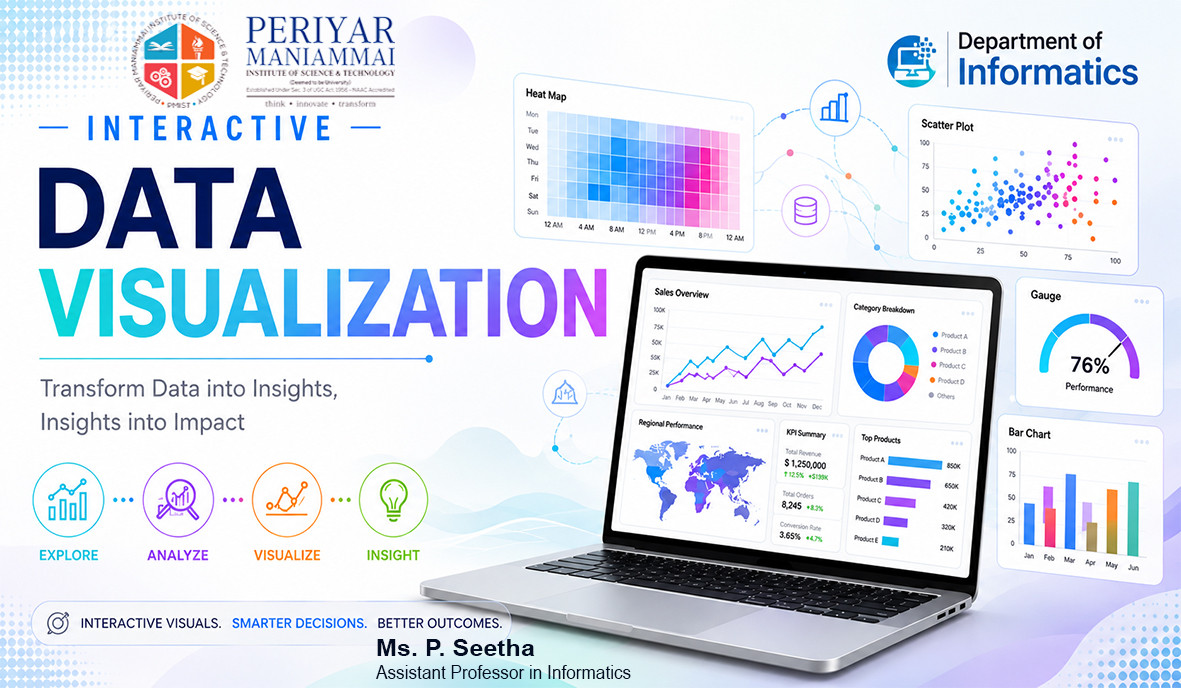
This Interactive Data Visualization course offers a comprehensive foundation in modern data visualization, enabling students to design clear, perceptually accurate, and ethical data graphics for varied analytical problems. Emphasis is placed on selecting appropriate visual forms, representing uncertainty, handling multivariate and geospatial data, and communicating insights through narrative-driven, well-designed figures.
- Teacher: Centre for Innovative Learning (PMIST)
- Teacher: SEETHA P
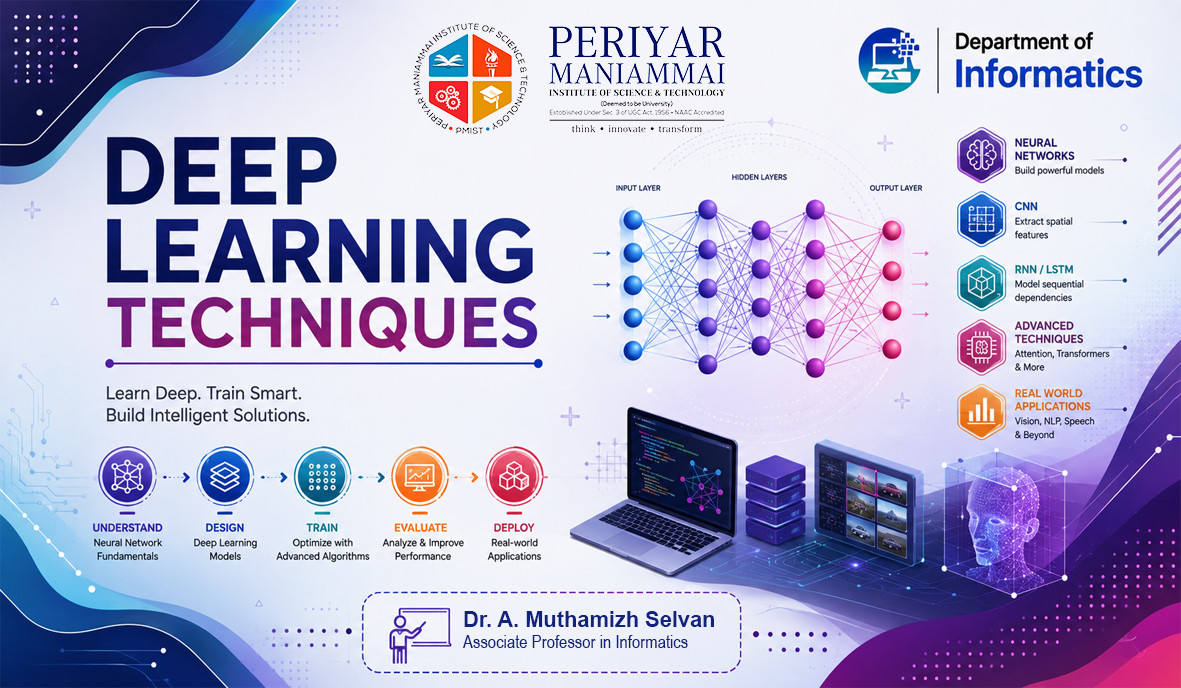
This Deep Learning Techniques course introduces the theoretical foundations and algorithms of Deep Learning, beginning with perceptron and feedforward neural networks and progressing through convolutional and recurrent architectures, optimization strategies, auto-encoders, and generative models. The course emphasizes the mathematical rigor and conceptual depth needed for research and industry applications in AI, computer vision, and natural language processing.
Course Outcomes:
| COs | Description | Cognitive Levels |
| CO1 | Describe the artificial neurons, activation functions, and multilayer perceptron. | Understand (K2) |
| CO2 | Experiment optimization methods and adaptive learning techniques. |
Apply (K3) |
| CO3 | Analyse CNN architectures and regularization techniques for computer vision tasks. |
Analyze (K4) |
| CO4 | Compare RNN, LSTM, and GRU models for sequence modeling tasks. |
Analyze (K4) |
| CO5 | Evaluate various autoencoder types and generative models for representation learning. |
Evaluate (K5) |
| CO6 | Integrate deep learning concepts into real-world AI applications responsibly. | Create (K6) |

Skip courses
Courses
Skip site announcements