
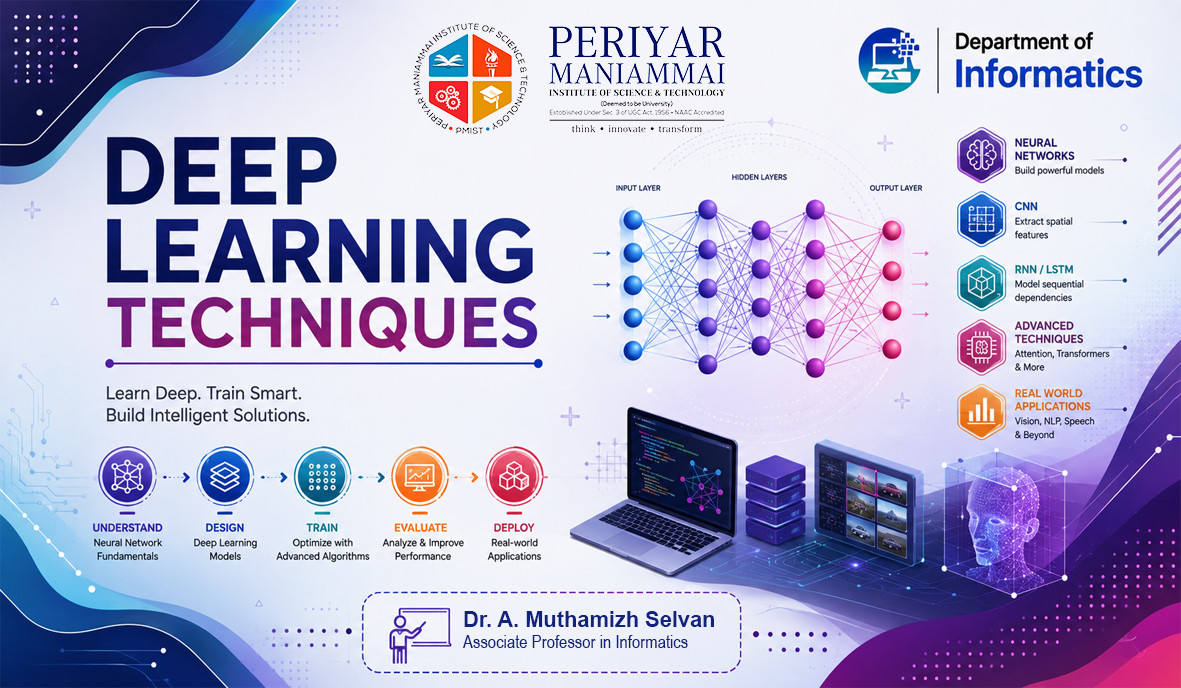
This Deep Learning Techniques course introduces the theoretical foundations and algorithms of Deep Learning, beginning with perceptron and feedforward neural networks and progressing through convolutional and recurrent architectures, optimization strategies, auto-encoders, and generative models. The course emphasizes the mathematical rigor and conceptual depth needed for research and industry applications in AI, computer vision, and natural language processing.
Course Outcomes:
| COs | Description | Cognitive Levels |
| CO1 | Describe the artificial neurons, activation functions, and multilayer perceptron. | Understand (K2) |
| CO2 | Experiment optimization methods and adaptive learning techniques. |
Apply (K3) |
| CO3 | Analyse CNN architectures and regularization techniques for computer vision tasks. |
Analyze (K4) |
| CO4 | Compare RNN, LSTM, and GRU models for sequence modeling tasks. |
Analyze (K4) |
| CO5 | Evaluate various autoencoder types and generative models for representation learning. |
Evaluate (K5) |
| CO6 | Integrate deep learning concepts into real-world AI applications responsibly. | Create (K6) |